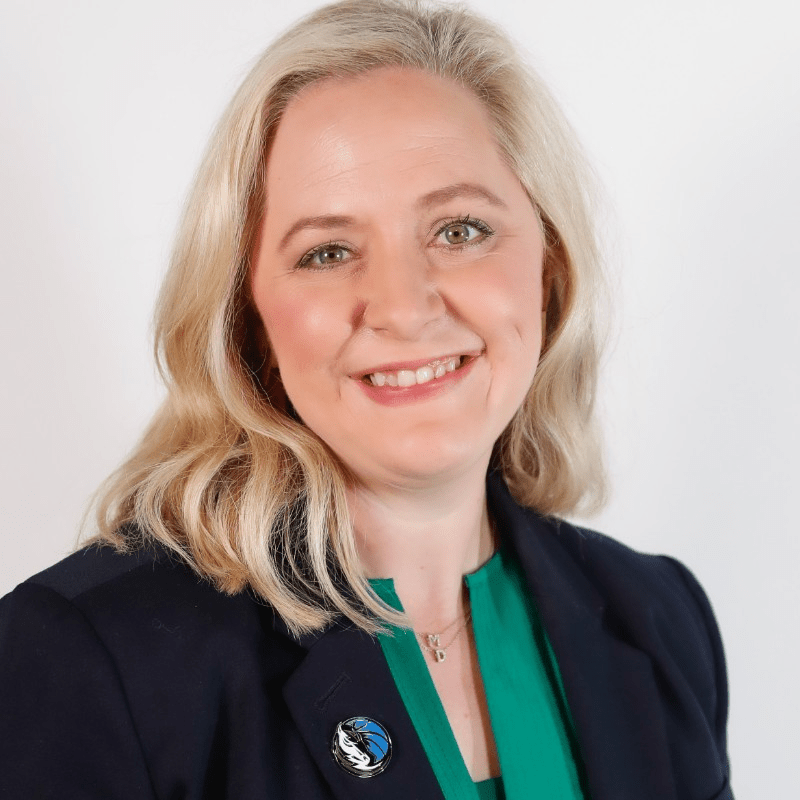
Katie Edwards
Chief Impact Officer & President Mavs Foundation, Dallas Mavericks
“Katie Edwards leads community impact, youth programs, events, and player relations for the Mavericks while overseeing the Mavs Foundation. With 25+ years of experience, she’s built her career on trust, integrity, and relationships—rising through the organization to Chief Impact Officer.
Mentored by Mavericks CEO Cynt Marshall, Katie champions people-first leadership, diversity, and inclusion. She believes in the power of sports to unite communities and lives by balancing her career with family, music, and travel.
✨ Thank you, Katie, for inspiring women in sports business to lead with purpose and integrity!”
– Zara
Please describe your role & responsibilities at that position?
I lead the external affairs for the organization including our community and charitable work and the Mavs Foundation (a separate 501c3 private foundation), as well as our youth basketball programs, the Events team and player relations.
What did you study in college and how did your educational background shape your career in the sports industry?
My degree is in Business Administration with a concentration in Marketing, along with a minor in Communications/PR. I believe my degree gave me a broader understanding of business and allowed me access to a wider range of positions following college. I encourage students to understand all areas of business from finance/accounting to marketing/branding as it helps both in cross-departmental relationships and understand and potential leadership roles down the road. I also encourage students to take internships from several different industries to help identify where your strengths are best utilized and the people you want to work with.
Can you share the key milestones in your career that led you to your current position in the sports industry?
My career journey expands over 25 years. It begins with internships at banks in college when I was originally an Accounting major. Those internships led me to an understanding that banking was not for me and I switched my concentration to Marketing and took internships with a marketing agency, and specifically PR firms. My last internships in college were in Sports Marketing with the San Antonio Spurs.
Following my internships with the Spurs, I was offered a position with the NCAA Alamo Bowl, however at that time I did not want to pursue a sports job (understanding the irony now) and moved to Dallas and took a position with a PR/publicity firm for motion pictures.
I learned a lot about myself and what I want for my career from that first job. It was a very small office that managed publicity for large movie studios like Universal and Columbia Pictures. As several other employees left, I became the sole employee responsible to the studios and representing us and our strategies for Dallas among the other top 10 markets across the US. While I loved the excitement of promoting new films and hosting screenings, I found that I did not enjoy the people in the industry. Calls with studios were contentious, cut throat and competitive – not a team effort or collaborative. But my decision to change course came when the owner of the firm asked me to “fudge” the numbers from our screenings – changing our demographics and results to look better than other markets. These numbers were outside the results from other cities and I was left to explain why our numbers were so different on a national call, called out and held accountable for inflating our results. That was when I decided I needed to leave. A hard lesson in understanding your values and what you will and will not do – if your company aligns with your principles and beliefs of right and wrong.
I had a few family members in the nonprofit world who helped me understand the importance of corporate culture – it’s not just the job, it’s about the people you work with and where you find meaning in your work. I starting using my connections from college and other internships (importance of your network!) to explore positions in the nonprofit/philanthropy industry and landed a position in Marketing with a Dallas nonprofit consulting firm, the Center for Nonprofit Management.
There I found my greatest strengths were in relationship building. Over 15 years there, I started as a Marketing Coordinator, to Director of Marketing, to VP of Marketing and ultimately VP of Programs & Operations/COO over several departments and 2nd to the CEO. I earned each and every promotion by building trust and taking on more and more responsibility – people relied on me and valued my inclusion as someone who could help them.
After 15 years at CNM, I decided it was time for a change and looked to move to Corporate Philanthropy. Once again, my connections and strong network helped to secure my position at the Dallas Mavericks. The Mavs CEO at the time, Terdema Ussery, was on the board of a nonprofit, Communities Foundation of Texas, whose President happened to be a friend and one of my references. Terdema was looking for someone who was well connected in the Dallas nonprofit community and I joined the Mavs as Director of Community Relations.
I’ve been with the Mavericks for 11 seasons and have grown in my role under several different leaders from Director, to Sr. Director, to VP of Corporate Social Responsibility and to my current role as Chief Impact Officer joining all of our external departments together.
What are some of the biggest challenges you’ve faced as a woman in the sports business, & how have you overcome them?
Luckily, I joined the Mavericks several years into my career and I was comfortable with my role as a leader and not afraid to use my voice. As a reserved introvert, my natural instinct is to listen first but over the course of my career I learned that my opinions and leadership were valuable.
While sports business is still majority men in leadership roles, I think it is evolving to value the contributions of each person, regardless of gender, race or any other differentiator.
I appreciated the opportunity to join women’s leadership courses and certifications that helped me to speak up for myself and understand the value of different kinds of leaders (see the topic of Quiet Leadership) that helped make me more visible to leadership.
Again, I think it’s about the value you provide and earning respect from peers and leadership. It takes a bit more intentional work from women, to be seen and respected and not dismissed or ignored.
Balancing a career is demanding. How do you manage a work-life balance? What strategies have worked well for you?
My former CEO Cynt Marshall talks about “work-life integration” instead of balance. Everything integrates. You might have work events at night or over the weekend, but you also might take your child to a doctor’s appointment during the day or skip a meeting to go to their basketball game.
It’s a challenge to keep all of the plates spinning. It’s not easy work and can be stressful and overwhelming – but it comes down to priorities. Cynt talks about “crystal balls” and “rubber balls” – which things will bounce back if they drop vs. which ones will break. You have to focus on caring for the crystal balls – understand the things that are priority for either work or family.
How important is mentorship for women in the sports industry? Have you had mentors or role models who played a significant role in your career and can give some details?
Cynt Marshall is integral to me as a mentor and role model for women in sports – she believed in me and supported me. I learned from her how to be a people-centric leader – caring for others as core to creating a successful business.
Beyond Cynt, I value the friendships and trust I share with my peers both at the Mavericks and connections at other companies. People who you can lean on, learn from and share experiences.
In a male-dominated industry, do you feel women are given equal opportunities? What steps do you think can be taken to promote gender equality in the sports industry?
Again, in sports and in other industries, people tend to hire people who are like them. If a company is male-dominated, it will continue to be so until someone makes an intentional choice to change it. It takes intention to be aware of the demographics of leadership tables and understanding the importance of diversity at those tables. Understanding that difference is what makes us stronger. I value people who are different than me because they bring different strengths, different perspectives – it takes courage to open yourself to be vulnerable and say my way may not be the only way and be open minded to others. Companies and leaders of those companies need to have the same courage to gather diverse teams who are stronger together.
What aspects of your work in the sports industry do you enjoy the most? What parts do you find the most challenging ?
I love working in sports because of its power to bring people together regardless of background or where we come from, we can all come together to cheer on our team. It’s a community, provides a sense of belonging, and I love that I can be a part of bringing that community together.
The most challenging is work-life integration and that our work in sports goes beyond the traditional 9-5 work day. We get to experience the highs of winning championships and how it feels to take your team to the Finals, but also the grind of events day after day with little time off.
What advice do you have for young women aspiring to build a successful career in the sports industry?
I believe I’ve advanced in my career not because of our results (although I’m very proud of our programs and the reputation we have earned for our work) but because of my emotional intelligence and trust-building and working with people. The ability to listen and understand others, to bring groups together, and support others – focusing on what you can do for other people and teams, rather than focusing on self promotion and success. Be the person people WANT to work with because of how you help them. Be that trusted ally to your peers and your leadership.
What is your long-term personal goal that you still want to achieve both business wise and personal?
I’m still trying to figure out what I want to do when I grow up. Careers are long, long roads and I want to be open to what’s next. A way for me to continue in work that gives me purpose and personal value, while also giving me the ability to focus on my family.
Any fun facts or interesting things you’d like the world to learn about you? Favorite food, hobbies, pet peeves, etc.?
My family is my world – my husband Glen, my two kids Maddie and David, my mom and my twin sister Jenny.
I love to travel with them and experience new places and cultures, along with the comfort and relaxation of the beach or the mountains. With the fast pace of the sports world – I appreciate the opportunity to slow down and unplug.
Unlike many of my peers in sports, I am not an athlete. I come from a family of musicians and fun fact, I started as a vocal performance major in college. I’ve always been a singer and did musical theater growing up. I believe the power of sports aligns with my passion for the arts and entertainment – the audience as a community coming together to experience something together.
 Women in Sports Business